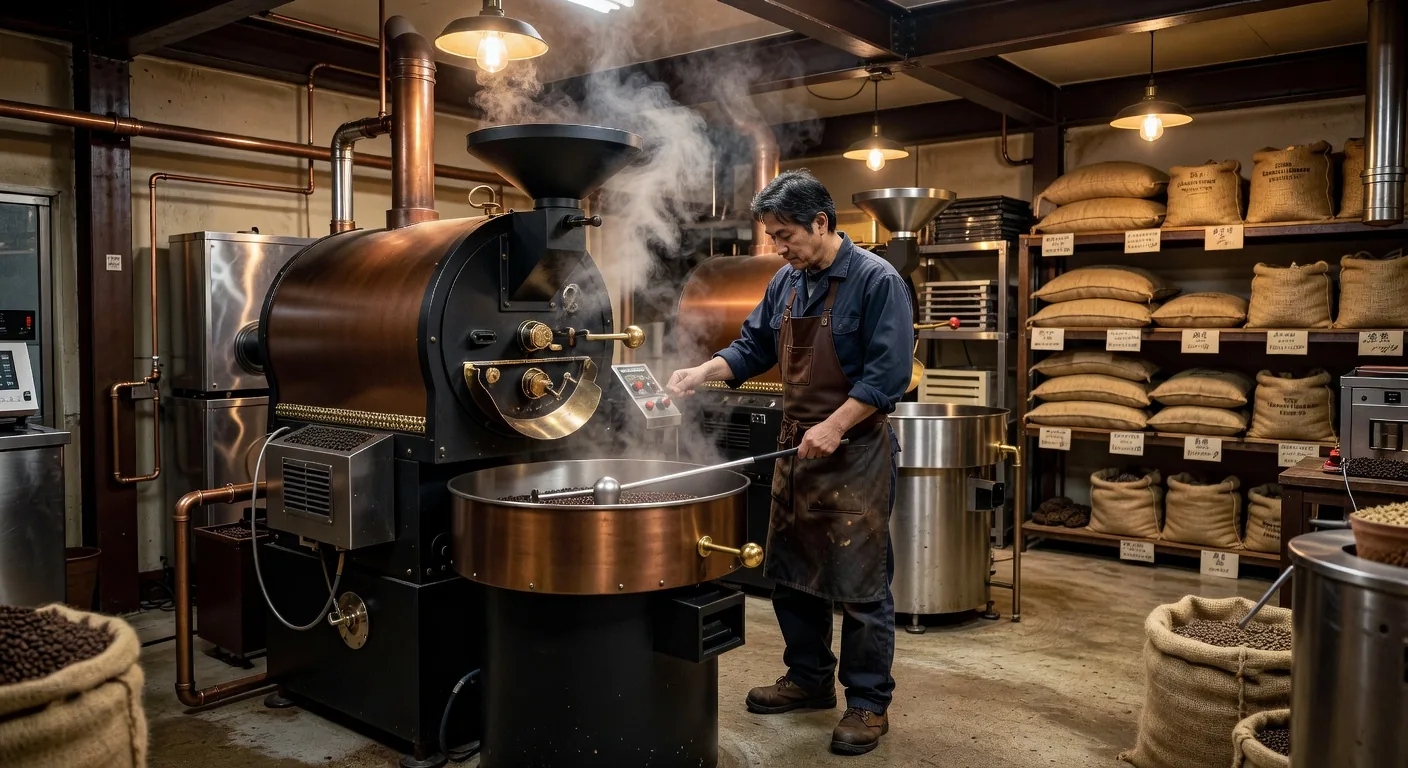
Japanese Roasting: Precision in the Drum
Japan has a long and distinguished tradition in coffee roasting. Unlike the light-roast orthodoxy that dominates third-wave culture globally, Japan's roasting tradition celebrates the full spectrum — from the delicate, tea-like light roasts favoured in Tokyo's specialty scene to the deep, resonant dark roasts that defined kissaten culture for generations.
The Japanese roaster approaches the craft as a balance of science and intuition. Every origin behaves differently in the drum; mastery lies in reading each batch as an individual — responding to colour, aroma, and sound rather than simply following a fixed profile.
Established roasteries like Fuglen, Onibus, and Single O Japan have brought this philosophy to an international audience, proving that Japanese roasting belongs in the same conversation as the finest in the world.
Understanding the Roast Spectrum
From the bright, fruity notes of a light roast to the bittersweet depth of a dark roast — each level tells a different story.
Light Roast (浅煎り)
Bright, complex, tea-like. Internal temperature reaches 196–205°C. All the origin characteristics of the green coffee are preserved. Preferred by Tokyo specialty cafés for pour-over and filter brewing.
Medium Roast (中煎り)
Balanced sweetness and body. Temperature: 205–218°C. The sweet spot for espresso and Aeropress. Origin flavours are balanced with roast-derived caramel and chocolate notes. Most versatile roast level.
Medium-Dark (中深煎り)
Rich body with bittersweet character. Temperature: 218–229°C. The traditional kissaten roast level. Deep, satisfying, complex. Nel drip and siphon brewing methods are designed for this roast profile.
Dark Roast (深煎り)
Bold, smoky, intensely bitter-sweet. Temperature: 229°C+. The backbone of blended canned coffees and traditional blend roasting. Often undervalued by third-wave culture but deeply satisfying in its proper context.
Japanese Coffee Terms Explained
Essential vocabulary for navigating Japan's café culture.
Coffee Origins Loved in Japan
The producing countries that appear most frequently on Japanese café menus and why they resonate with Japanese coffee culture.
Ethiopia
Japan's most beloved origin. The floral, tea-like clarity of Ethiopian naturals aligns perfectly with Japanese aesthetic sensibility.
Yemen
Rare, complex, and deeply historical. Yemeni coffees have a devoted following in Japan's specialty scene for their wild, winery character.
Colombia
Consistent, versatile, and deeply complex. Colombian coffees provide the reliable backbone of many Japanese café blends and seasonal menus.
Kenya
Kenyan AA has long been a prestige choice in Japanese specialty cafés. The intense blackcurrant acidity and full body create unforgettable cups.
Guatemala
A classic match for Japanese dark roasting traditions. Guatemalan coffees develop extraordinary caramel depth and chocolatey richness in the kissaten style.
Brazil
The foundational origin of countless Japanese kissaten blends. Brazilian naturals provide the low-acid, nutty, full-bodied base that defines classic Japanese coffee shop blends.
Coffee in Japan: A Brief History
From the first cup to the third wave.
Frequently Asked Questions
Tokyo offers the greatest variety and concentration of specialty cafés, but Kyoto's café culture has a unique, contemplative quality that many visitors find more memorable. For morning set culture, Nagoya is unmatched. Each city has a distinctive coffee character — we recommend visiting at least two to compare.
A kissaten (喫茶店) is a traditional Japanese coffee house, typically opened before 1990, independently owned, and characterised by a slower pace of life, classical or jazz music, and often deeply roasted hand-drip coffee. Modern cafés (カフェ) are generally newer, may serve food more prominently, and often have brighter, lighter interiors. Both are worth experiencing.
Japan is arguably the world's best destination for specialty coffee lovers. The combination of precise, thoughtful brewing, exceptional imported equipment, high-quality barista training, and a deep cultural reverence for the craft creates an environment where extraordinary coffee is simply the expectation, not the exception.
A standard drip coffee in a kissaten runs ¥500–¥800. Specialty pour-overs at third-wave cafés typically cost ¥800–¥1,500 per cup. Premium single-origin options or siphon brews at renowned establishments may reach ¥2,000–¥3,000. Coffee in Japan is generally regarded as excellent value relative to the quality offered.
The morning set (モーニングセット) is a uniquely Japanese café tradition, particularly concentrated in Nagoya, where ordering a coffee in the morning hours (typically before 11am) automatically includes a free breakfast — usually thick-cut toast, a boiled egg, and sometimes salad or jam. It's one of the most charming rituals in Japanese food culture.
Decaf options are growing but remain limited, particularly in traditional kissaten. Most specialty cafés in Tokyo and Osaka now offer oat milk; soy milk has been available in most cafés for many years. In smaller cities and traditional coffee houses, dairy alternatives may not be available. It's worth checking in advance or using the phrase "nyu-nyū wa arimasu ka?" (Do you have non-dairy milk?)
Get in Touch
Have a café to recommend? A correction to suggest? A story to share? We'd love to hear from you.
1-12-4 Sakae, Nagoya, Japan
Fresh Paint Service — Japanese Coffee Culture Guide