Feature · June 12, 2026
The Quiet Revolution
How Japanese Baristas Are Redefining Specialty Coffee
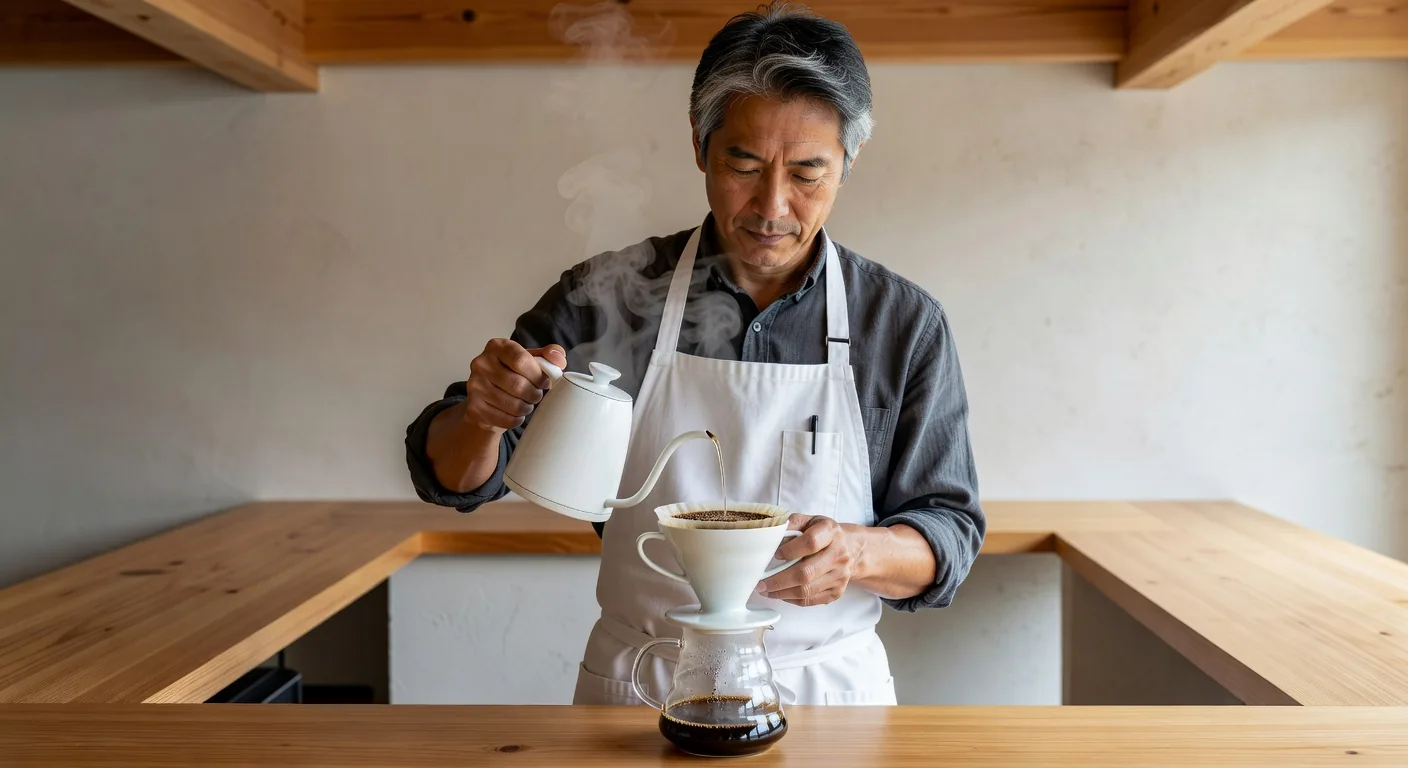
At precisely 9:47am on a Tuesday morning in Shimokitazawa, Ryu Nakamura calibrates his Acaia scale for the third time. The Yirgacheffe he is about to brew was roasted five days ago — the optimal window, he explains, between the aggressive brightness of fresh roasting and the onset of staling. He grinds 22 grams. He notes the humidity. He heats his ceramic V60 to exactly 94°C.
Outside, the neighbourhood is slowly awakening. But in this narrow, 8-seat café — its white walls hung with single framed botanical prints, its playlist a barely-audible succession of ambient recordings — time operates differently. Nobody is in a hurry. Nobody is on their phone. Two regulars sit at the counter in companionable silence, warming their hands around pale ceramic cups.
"Every detail matters. But the most important thing is presence — bringing yourself fully to the moment of brewing. The coffee will tell you everything, if you listen."
The Precision Obsession
Japan has produced more World Barista Champions and World Brewers Cup winners per capita than any other country. This is no accident. The same cultural values that produce master swordsmiths, Michelin-starred sushi chefs, and legendary potters also, it turns out, produce extraordinary baristas.
The Japanese concept of shokunin — loosely translated as "craftsman" or "artisan" — encompasses a lifelong commitment to mastery through daily practice. A ramen shop owner who has made the same broth for 40 years, a tea ceremony master who has bowed the same bow 100,000 times — these figures represent an ideal that coffee in Japan has wholly absorbed.
What makes this revolution "quiet" is its nature: this is not disruption, not innovation for its own sake, not the aggressive entrepreneurialism of Silicon Valley coffee culture. It is, instead, an infinitely patient refinement. A commitment to doing one thing — making excellent coffee — better and better, every single day.
The Global Impact
The influence of Japanese coffee philosophy is now felt globally. The Hario V60 is standard equipment in specialty cafés from Oslo to Melbourne. The four-six brewing method, created by Tokyo barista Tetsu Kasuya, is the most widely adopted alternative brewing recipe in the world. And the concept of the "standing espresso bar" — elegant, precise, unhurried — has its spiritual home in Tokyo even if the format originated in Italy.
As Nakamura places the finished cup on the counter and steps back — never hovering, never seeking approval — a visitor from London picks it up and inhales. There is a long moment of silence. Then a quiet sound of something close to disbelief. How is this possible from a coffee bean?